




Most professionals spend the majority of their workday on tasks that don’t require their judgment. Scheduling, data entry, email drafting, report formatting, meeting notes: work that fills the calendar and empties creative bandwidth. We tested the most effective AI automation workflows across dozens of real work scenarios to find what actually eliminates that load rather than just rearranging it. The difference between working with AI and working without it in 2026 is not a productivity edge. It’s a different category of work entirely.
What Does It Mean to Automate Repetitive Tasks With AI?
Using AI to automate repetitive tasks at work is not about replacing your job with a robot. It is about hiring digital teammates to handle the work that requires zero judgment so you can spend your actual cognitive capacity on the work that requires all of it.
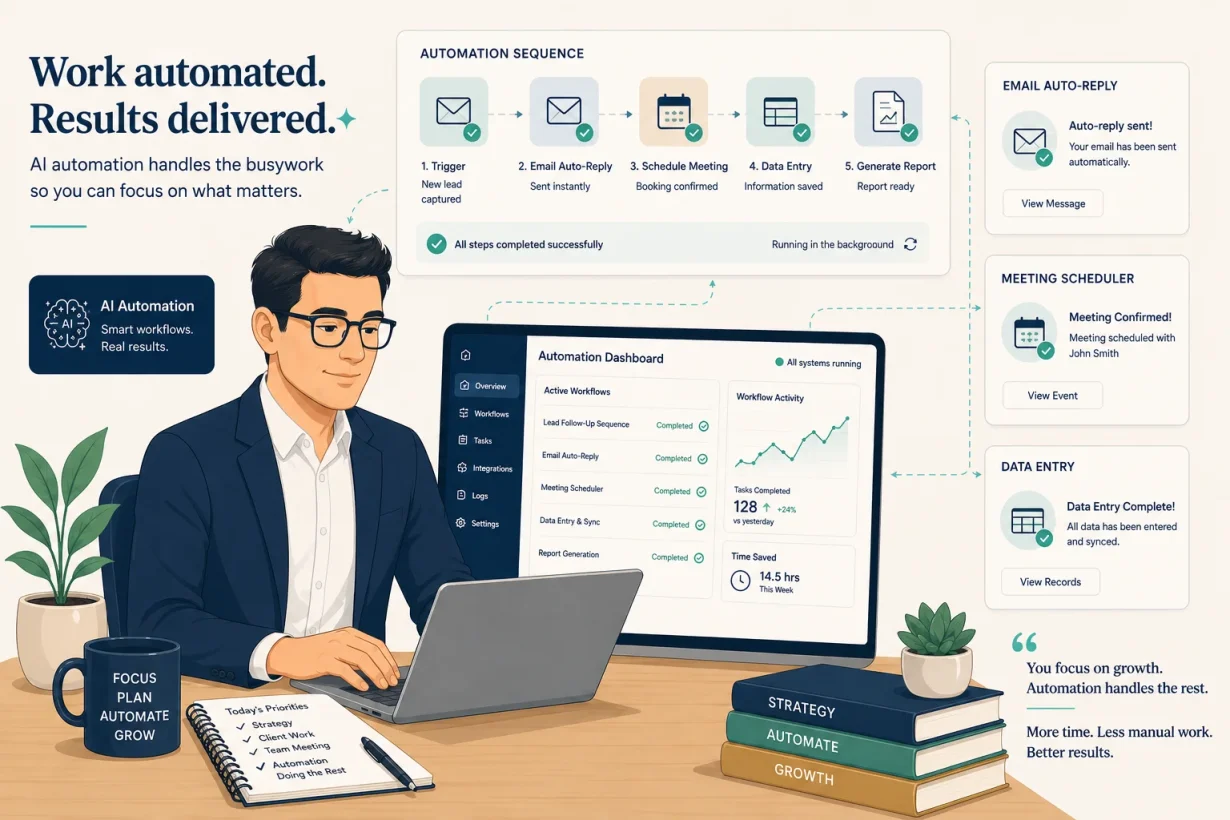
These aren’t just smarter to-do lists. They are autonomous systems that execute recurring workflows without your daily input: reading and routing emails, transcribing and summarizing meetings, categorizing data, scheduling appointments, generating standard reports, and triggering follow-up sequences based on conditions you set once and forget. AI doesn’t automate your job. It automates the parts of your job that were never worth your time in the first place.
59% of employees report that AI helps them complete repetitive tasks faster, and teams using AI for scheduling meetings spend 35% less time coordinating calendars. That’s time that compounds across every week of every working year.
Why Automating Repetitive Tasks With AI Matters in 2026
Are you still manually doing work that your AI stack could handle before you finish your morning coffee?
Workers’ throughput of realistic daily tasks increased by 66% when using AI tools, equivalent to decades of natural productivity gains compressed into the span of a single technology adoption cycle. That number isn’t a projection. It’s a measured outcome from controlled studies comparing AI-assisted and non-AI-assisted knowledge workers on identical task sets.
AI tools automate repetitive tasks such as data entry, email drafting, scheduling, and customer support, saving employees several hours each week, allowing them to spend less time on repetitive tasks and more time on creative, strategic, and meaningful work. The professionals who feel overwhelmed in 2026 are not the ones with the most work. They are the ones still doing manually what AI handles automatically.
How to Use AI to Automate Repetitive Tasks at Work: The 5-Step Framework
Step 1: Audit Your Week for Automation Targets
Before you automate anything, you need to know what is actually consuming your time. Spend one week tracking every task you complete that follows a predictable pattern: same input, same process, same output, repeated regularly. These are your automation targets.
The highest-value automation targets share three characteristics: they happen frequently (daily or weekly), they follow a consistent process that doesn’t require contextual judgment, and they consume time disproportionate to the value they produce. Data entry, meeting scheduling, email routing, report generation, and file organization consistently top this list across knowledge worker roles.
A simple rule: if you have done it the same way more than five times, AI can probably do it for you from now on.
Step 2: Match Each Task to the Right Automation Layer
Not all repetitive tasks require the same type of AI. Using the right tool for each task type is what separates automation that runs reliably in the background from automation that creates more work than it saves.
Three automation layers cover the majority of repetitive workplace tasks:
- AI writing assistants (ChatGPT Plus, Grammarly): For email drafting, report generation, meeting agenda preparation, and any text-based output that follows a consistent format. Feed a template and context once; the AI produces publish-ready output every time.
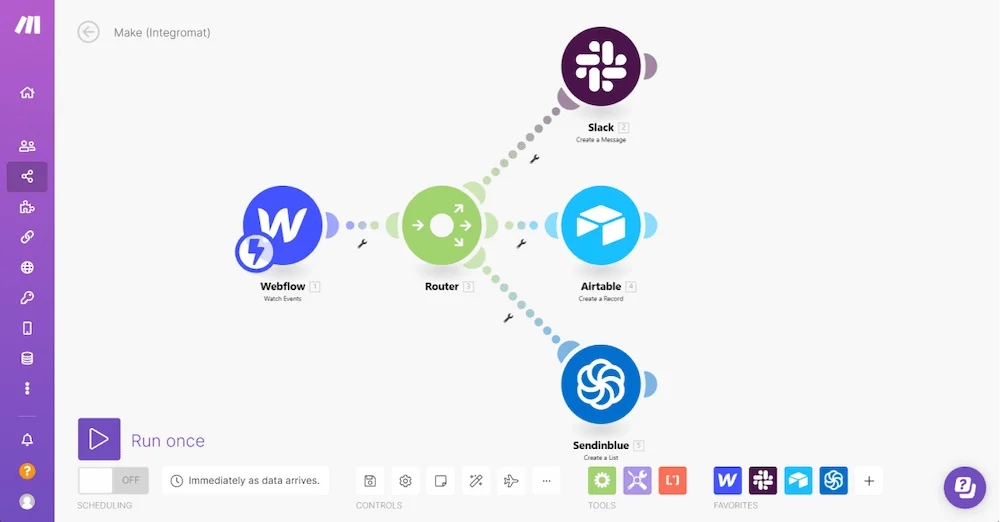
- Workflow automation platforms (Zapier, Make): For multi-step processes that connect multiple tools: new form submission triggers CRM entry triggers welcome email triggers calendar booking, all without touching any of it manually. These platforms connect 6,000 or more apps and handle the handoffs between them automatically.
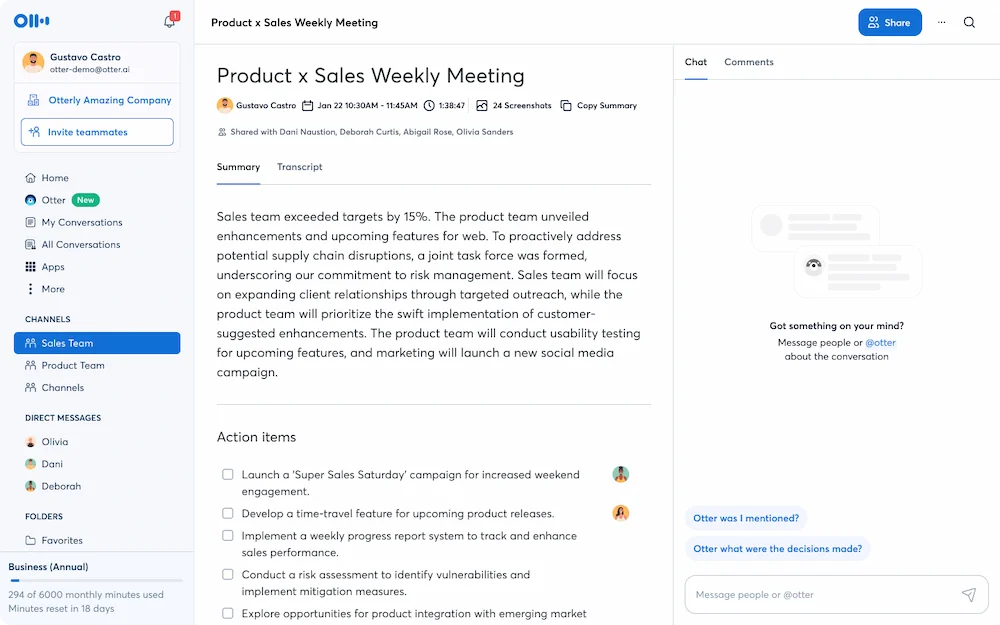
- Meeting intelligence tools (Otter.ai, Fireflies.ai): For transcription, summarization, and action item extraction from every call. Zero manual note-taking; structured outputs delivered to your inbox the moment the call ends.
Match your audit from Step 1 to the layer that fits each task. Writing tasks go to AI assistants. Multi-app handoffs go to workflow automation. Meeting and communication overhead goes to meeting intelligence tools.
Step 3: Build Your First Automation in Under 30 Minutes
The barrier to automating repetitive tasks with AI is not technical. It is psychological. Most people wait for a perfect understanding of every tool before starting. The right approach is the opposite: start with one high-frequency task and automate it today.
Pick the single repetitive task from your audit that consumes the most time per week. Then follow this three-part build sequence:
Define the trigger: What event starts this task? A new email arrives. A form is submitted. A meeting ends. A file is uploaded. Every automation starts with a trigger.
Define the action: What needs to happen automatically when the trigger fires? Send a response. Create a record. Generate a summary. Move a file. Update a spreadsheet. One clear action per automation, at least to start.
Define the output destination: Where does the result go? Your CRM. Your project management tool. Your inbox. A shared folder. A Slack channel.
Build this in Zapier or Make using the AI Zap builder: describe the automation in plain English and the platform builds the workflow for you. The first automation typically takes 20 to 30 minutes to set up and runs indefinitely from that point forward. Humans spend time setting up; AI spends none running it.
Step 4: Automate Your Meeting and Communication Overhead
Meeting overhead is the most underestimated source of repetitive work in knowledge-worker roles. The average professional attends eight to twelve meetings per week and spends 30 or more minutes per meeting on notes, summaries, and follow-up emails. That’s four to six hours per week of work that AI eliminates entirely.
Connect Otter.ai or Fireflies.ai to your calendar. From that point forward, every meeting is automatically transcribed, summarized, and delivered to your inbox with action items extracted. No manual notes. No post-meeting writeups. No reconstructing what was decided three days later.
Employees using AI for data entry reduce errors by 27%, improving overall workflow accuracy. The same pattern holds for meeting documentation: AI-generated summaries are more complete, more consistent, and produced faster than manual notes taken under the cognitive pressure of simultaneously following the conversation.
Step 5: Stack Automations Into a System
Individual automations save minutes. Stacked automations connected to each other save hours. The compound effect of AI automation at work comes from chaining individual workflows into systems that run entire processes without your involvement.
A practical example: a client inquiry arrives via your contact form. Zapier routes it to your CRM and sends a personalized acknowledgment email. Otter.ai joins the follow-up discovery call and generates a summary. Zapier sends that summary to your project management tool and creates a task for the next step. ChatGPT Plus drafts the proposal from the project brief. The entire client intake process from first contact to proposal draft runs on AI. Your involvement starts when strategic judgment is actually required.
AI boosts productivity by 40% on average across sectors, from manufacturing to services. That gain scales faster for workers who build systems rather than isolated automations, because connected workflows eliminate the handoff time between tools that manual processes leave unaddressed.
Which Automation Approach Fits Your Work?
Individual contributors vs. team leads
Individual contributors benefit most from automating personal productivity overhead: email drafting, meeting notes, scheduling, and report generation. The right starting stack is ChatGPT Plus for writing tasks, Otter.ai for meetings, and Reclaim AI for calendar protection. Team leads need automation that spans multiple people and tools: Zapier or Make to connect team workflows, and Notion AI to maintain a shared knowledge base that everyone can query without asking each other.
Low-tech comfort vs. technical confidence
Professionals with low technical comfort should start with AI writing assistants and meeting intelligence tools. Both deliver immediate value with zero workflow configuration. Grammarly installs in two minutes. Otter.ai connects to your calendar in five. No automation logic required. Professionals with higher technical confidence should go directly to Zapier or Make and build the multi-step workflows that create the largest time savings. The AI Zap builder means you describe what you want in plain English; the platform handles the logic.
Automating existing processes vs. redesigning workflows
Most professionals start by automating existing processes: taking what they already do manually and having AI do it instead. This delivers immediate time savings and requires no change management. The higher-leverage move is redesigning workflows around what AI can do natively: building processes that assume automation from the start rather than layering it on top of manual habits. The professionals seeing the largest productivity gains from AI automation at work are not doing the same work faster. They are doing fundamentally different work because the repetitive layer no longer exists.
Start Automating Smarter Today
Using AI to automate repetitive tasks at work shouldn’t feel like a technical project you need to schedule. It should feel like the natural next step once you realize how much of your workday doesn’t actually need you.
Not sure where to start? Read our complete guide to the best AI productivity tools in 2026 to see how each tool fits into a full automation system.
Frequently Asked Questions
What are the best AI tools to automate repetitive tasks at work?
The best AI tools to automate repetitive tasks at work are Zapier for multi-step workflow automation, ChatGPT Plus for writing and communication tasks, Otter.ai for meeting transcription and summarization, Grammarly for writing polish across all surfaces, and Make for complex multi-app automation at lower per-task cost than Zapier.
How much time can AI save by automating repetitive tasks at work?
Workers using AI to automate repetitive tasks at work report a 66% increase in task throughput, with individual time savings varying by role. Meeting overhead alone typically recovers 4 to 6 hours per week when automated with meeting intelligence tools. Email and report automation typically saves 1 to 3 additional hours per week.
Do I need technical skills to automate repetitive tasks at work with AI?
No. AI writing assistants and meeting intelligence tools require zero technical setup. Workflow automation platforms like Zapier include an AI builder that lets you describe automations in plain English. The most complex automations take 30 minutes to configure. Technical skills help with advanced conditional logic but are not required for the automations that deliver the most value for most workers.
Which repetitive work tasks are easiest to automate with AI first?
The easiest repetitive tasks to automate with AI first are meeting notes and summaries (Otter.ai, 5-minute setup), email drafting for recurring communication types (ChatGPT Plus, immediate value), calendar scheduling and focus block protection (Reclaim AI, same-day results), and form-to-CRM data routing (Zapier, 20-minute setup).
Is it safe to use AI to automate repetitive tasks at work with sensitive data?
For most business automation, yes. Enterprise-grade platforms like Zapier, Make, Notion, and ChatGPT Team use SOC 2 compliant security and do not train on your data by default on paid plans. For highly sensitive data including legal, healthcare, or financial records, verify the data processing agreements of each platform before connecting them to sensitive systems.
How do I know which repetitive tasks at work are worth automating with AI?
Apply the three-characteristic test: the task happens frequently (daily or weekly), follows a consistent process that requires no contextual judgment, and consumes time disproportionate to its value. If a task meets all three criteria, it is an automation candidate. Start with your highest-frequency tasks first and work down the list.