






Running a business alone used to mean choosing between growth and sanity. We tested 20+ platforms specifically against solopreneur workflows strategy, marketing, client management, and ops to find the ones that actually replace the roles you can’t afford to hire. Seven made the cut.
What Are AI Tools for Solopreneurs?
These aren’t productivity apps. They are the team you don’t have the strategist, the copywriter, the ops manager, and the researcher, all running simultaneously for the cost of a few subscriptions.
The distinction matters more for solopreneurs than anyone else. A freelancer needs tools that compress task time. A solopreneur needs tools that replace entire business functions. A complete solopreneur stack in 2026 operates between $3,000 and $12,000 annually a 95–98% reduction in operating costs compared to traditional staffing models. That gap is the business case.
Why Solopreneurs Need AI Tools in 2026
How many hours did you spend last week on work that didn’t require your judgment?
AI automation returns 10–40% of daily work time for solopreneurs by handling content, emails, customer support, and admin tasks. That’s 1–4 hours back in your day every day redirected from operational grind to the strategic work that actually grows your business.
Among solopreneurs surveyed in 2026, 74% have scaled their operations without hiring a single employee, leveraging AI automation to handle tasks that traditionally required full-time staff. The competitive advantage doesn’t belong to the best-funded operator anymore. It belongs to the best-tooled one.
How We Chose Our Testing Criteria
We didn’t rank these tools on feature counts or pricing pages. Every tool was tested against real solopreneur tasks over 90 days, scored on four criteria:
- Business function coverage: Does it replace a role, or just assist with a task?
- Solo-friendly setup: Time from sign-up to first useful result no team, no IT support.
- Stack integration: How well it connects to other tools in a solopreneur workflow.
- Affiliate-verified ROI: Tools we would pay for ourselves, with programs we’ve personally vetted.
The 7 Best AI Tools for Solopreneurs in 2026
1. Claude Pro
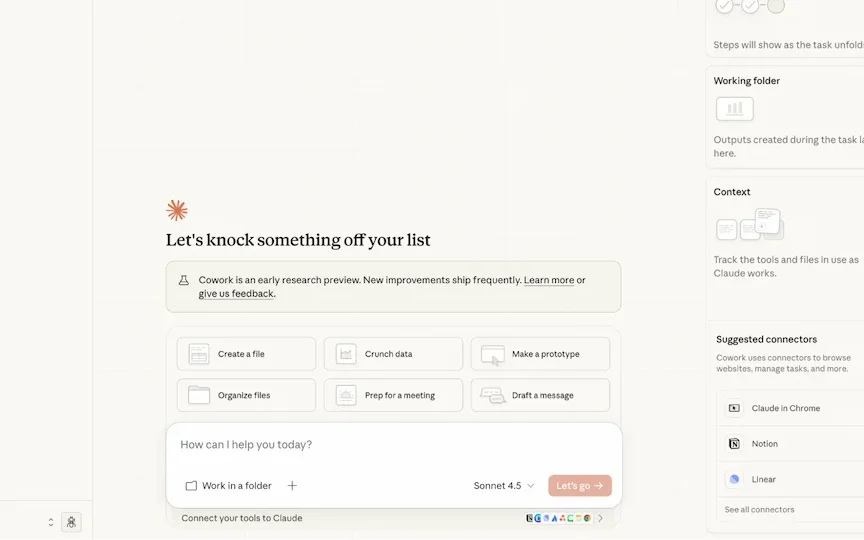
Claude Pro is the closest thing a solopreneur has to a senior strategist on retainer. Its 200,000-token context window means it can analyze an entire business plan, a full client contract, or six months of email history in a single conversation and reason across all of it simultaneously. Where most AI tools generate content, Claude Pro generates thinking.
Key features:
- 200K token context window: Analyze entire documents, contracts, and knowledge bases in one conversation no chunking, no copy-pasting.
- Deep reasoning: Fewer hallucinations on complex multi-step analysis than competing models critical when you’re making real business decisions.
- Projects feature: Persistent, organized AI workspaces that retain context across sessions “hire” Claude once per project and it stays briefed.
- Precise instruction-following: Handles complex, multi-part business requests without losing track of constraints or requirements.
Pros:
- Replaces your strategist, the highest-leverage use isn’t content generation it’s “here’s my business situation, my constraints, and my options what am I missing?” Claude Pro handles that conversation better than any other tool at this price point.
- Document intelligence, upload a client contract, a competitor’s pricing page, or a market research report and ask questions across it. That capability alone replaces hours of manual analysis per week.
Cons:
- No image generation, for solopreneurs who need visual content alongside strategic thinking, ChatGPT Plus covers that gap.
- Context resets on free plan, the full Projects feature that makes Claude genuinely persistent requires the Pro subscription.
Pricing:
| Plan | Price | Details |
|---|---|---|
| Free | $0 | Limited usage, no Projects |
| Pro | $20/month | Full context window, Projects |
| Team | $30/user/month | Shared workspaces |
For solopreneurs who make high-stakes decisions alone, Claude Pro at $20/month is the highest-ROI hire on this list. If you’re considering alternatives, take a look at our comparison of claude and chatpgt subscription plans.
2. Perplexity AI
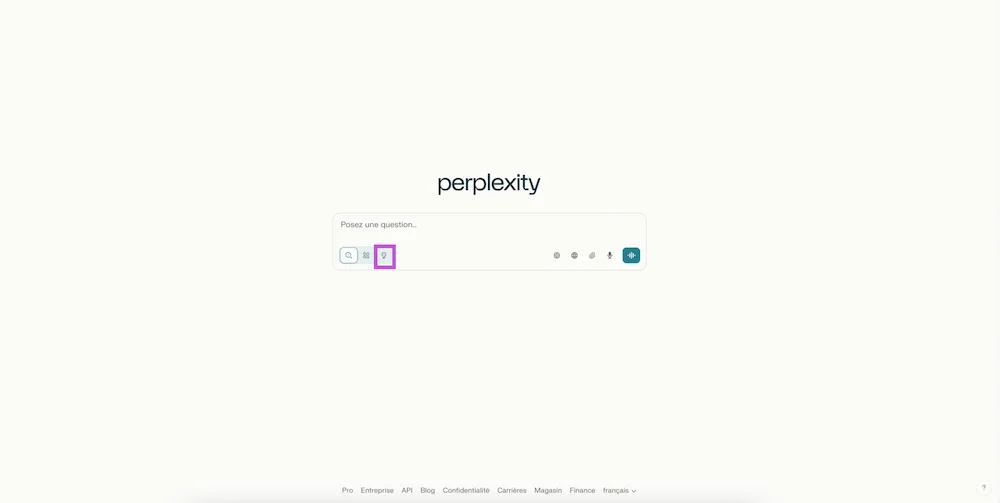
Perplexity AI is what Google should be. It searches the web in real time, synthesizes information from multiple sources, and delivers a sourced answer not a list of links to read manually. For solopreneurs doing market research, competitive analysis, or prospect background checks, it compresses hours of browsing into minutes.
Key features:
- Real-time web search: Every answer draws from current sources no knowledge cutoff, no outdated information.
- Source attribution: Every claim is cited with a link you can verify before you act on it.
- Follow-up thread: Ask follow-up questions in context, building a research conversation rather than starting over with each query.
- Perplexity Pro: Access to GPT-4o, Claude, and other models inside a single research interface.
Pros:
- Replaces your research assistant, competitive pricing analysis, prospect background checks, market sizing tasks that previously took 2–3 hours of browser tabs now take 10 minutes.
- Source-backed answers, unlike generic AI that confabulates confidently, Perplexity shows its work critical for business decisions where accuracy matters.
Cons:
- Not built for content creation, Perplexity is a research tool, not a writing tool. Pair it with Claude Pro or Jasper for the full workflow.
- Pro required for advanced models, the free tier uses a limited model serious research tasks benefit from the Pro upgrade.
Pricing:
| Plan | Price | Details |
|---|---|---|
| Free | $0 | Basic search, limited queries |
| Pro | $20/month | GPT-4o, Claude access, unlimited |
Perplexity Pro pays for itself the first time it saves you a two-hour research session. For solopreneurs making market-driven decisions, it’s non-negotiable.
3. Motion
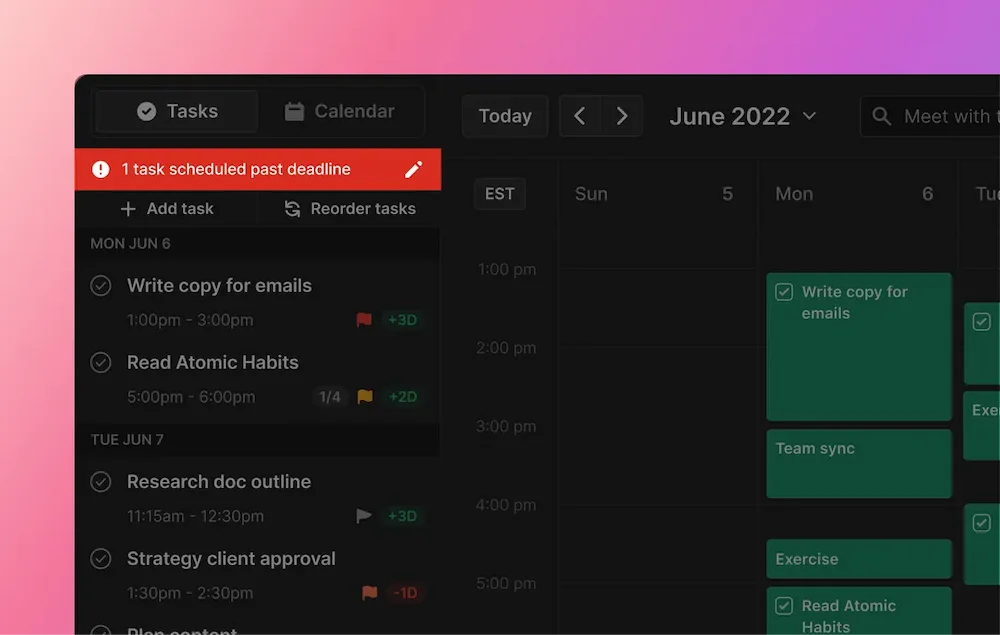
Motion is the only tool on this list that makes decisions so you don’t have to. Add tasks with deadlines and priorities, and Motion builds your entire schedule automatically rescheduling around new meetings and overruns in real time. For solopreneurs managing client delivery, business development, and operations simultaneously, it eliminates the daily cognitive overhead of “what should I work on next?”
Key features:
- Automatic rescheduling: Every task adjusts in real time when your day changes no manual intervention.
- AI time-blocking: Prioritizes by deadline and importance, protecting high-value work from being crowded out by reactive tasks.
- Project view: Tracks deliverables across all active client projects and business initiatives in one view.
- Calendar integrations: Google Calendar, Outlook, Zoom connects to the infrastructure you already use.
Pros:
- Eliminates scheduling decisions entirely, solopreneurs wearing five hats can’t afford to spend mental energy on calendar management. Motion handles it; you focus on execution.
- Compound effect over time, the longer Motion runs your schedule, the better it understands your workload patterns its decisions improve with your data.
Cons:
- Difficult first week, the adjustment period is real you’ll feel like you’ve lost control before you feel the benefit. Push through day 10.
- Requires task estimation, for highly unpredictable work where tasks can’t be scoped in advance, the system fights you rather than helping you.
Pricing:
| Plan | Price | Details |
|---|---|---|
| Individual | $19/month (annual) | Full AI scheduling |
| Team | $20/user/month | Collaborative planning |
Humans have bad days; Motion doesn’t. By week two, it’s making better scheduling decisions than you were because it optimizes across more variables than any person can hold in working memory simultaneously.
4. Notion AI
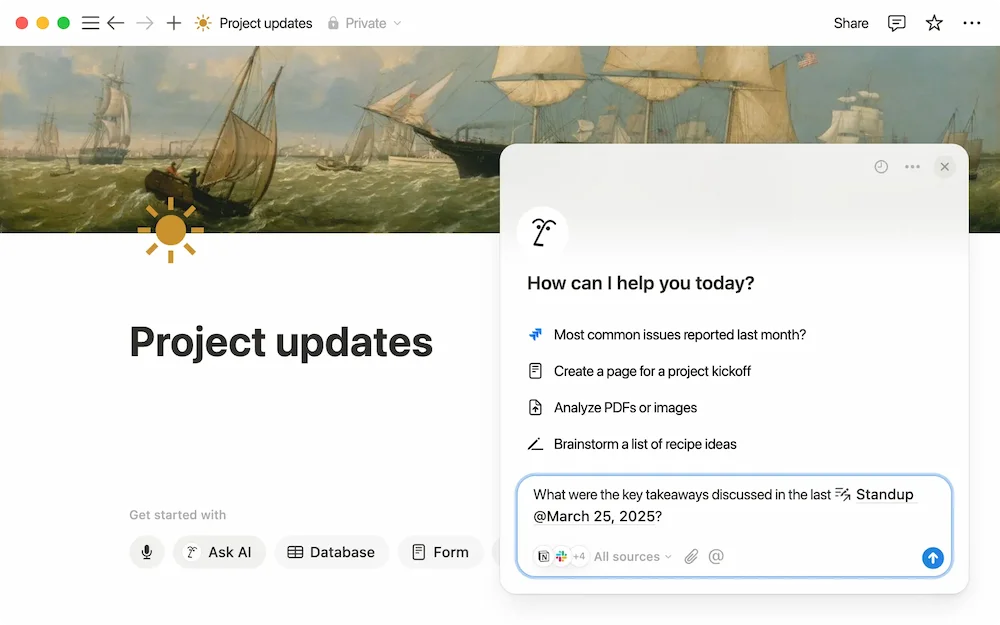
Notion AI is the operations layer of a solopreneur business. It doesn’t just store information it synthesizes it, surfaces it on demand, and turns raw inputs (meeting transcripts, client briefs, research notes) into structured outputs (action items, project plans, deliverable drafts) without leaving the workspace you already live in.
Key features:
- Cross-workspace knowledge synthesis: Ask “what did we agree on the Q2 roadmap?” and get a synthesized answer across every relevant page.
- Database autofill: Generate structured data from natural language populate project tables, client records, and content calendars from a single prompt.
- In-context drafting: Write proposals, SOPs, and client deliverables with full access to your stored business knowledge.
- $10/month add-on: Works with any Notion plan including free the highest ROI upgrade on this list.
Pros:
- Replaces your ops manager, Notion AI connected to a well-structured workspace handles the information management, retrieval, and documentation work that would otherwise require a dedicated role.
- Compound knowledge value, the longer you build in Notion, the more powerful the AI layer becomes it answers questions across years of accumulated business context.
Cons:
- Requires setup investment, the AI layer amplifies an existing Notion workspace expect 2–3 weeks of setup before it delivers full value.
- Not a standalone tool, if you don’t already use Notion as your business hub, this isn’t the right entry point.
Pricing:
| Plan | Price | Details |
|---|---|---|
| Free + AI | $10/month | AI on free Notion plan |
| Plus + AI | $18/month | More blocks + AI |
| Business + AI | $25/user/month | Advanced permissions |
Most solopreneurs underuse Notion AI. They treat it like a writing assistant. The actual power is using it as a search and synthesis layer across your entire business a second brain that remembers everything and surfaces it instantly.
5. Copy.ai
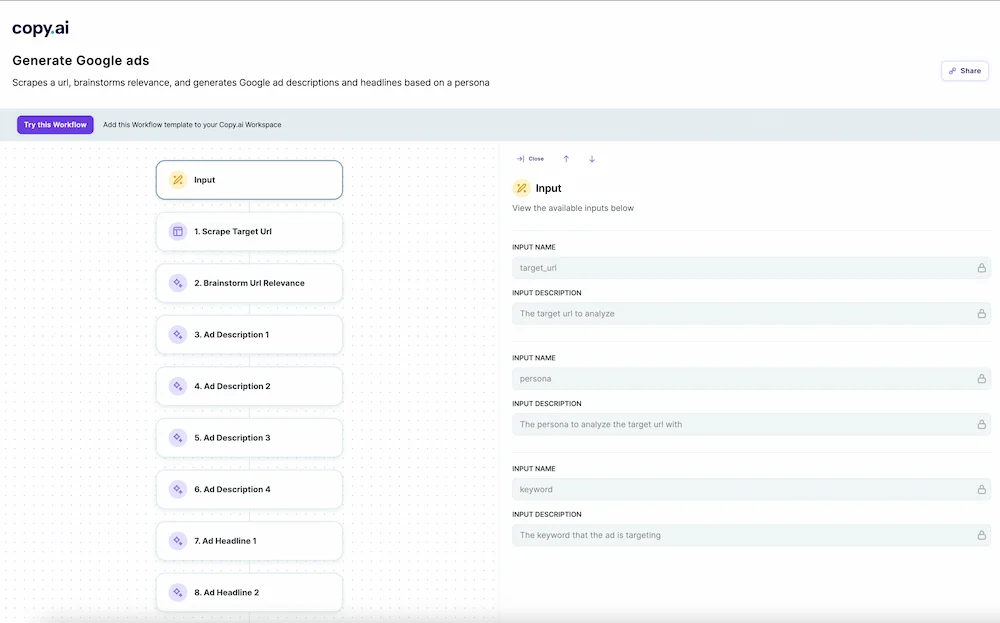
Copy.ai is the marketing team a solopreneur can’t afford to hire. Its GTM AI platform goes beyond writing it connects to CRM and product data to generate personalized marketing copy at scale, automates multi-step campaign workflows, and covers every marketing format from cold emails to landing pages to ad variations.
Key features:
- GTM AI platform: Pulls from real CRM and product data to generate contextually accurate marketing copy not generic output.
- Workflow builder: Automates multi-step copy generation pipelines brief in, campaign out.
- 90+ templates: Every marketing format a solopreneur needs, from cold outreach to product launch sequences.
- Unlimited words on paid plans: No per-word caps limiting your output volume.
Pros:
- Replaces your marketing team, a solopreneur using Copy.ai’s GTM workflows can run personalized outreach, content marketing, and paid campaigns simultaneously work that previously required a marketing hire.
- CRM integration, copy that pulls from your actual prospect data converts at significantly higher rates than generic AI output.
Cons:
- Overkill for content blogging, if your primary need is long-form editorial content, Jasper is the better fit. Copy.ai is built for go-to-market workflows, not blog posts.
- Learning curve on workflows, the GTM platform takes time to configure properly the out-of-box templates are useful, but the real power requires setup.
Pricing:
| Plan | Price | Details |
|---|---|---|
| Free | $0 | 2,000 words/month |
| Starter | $49/month | Unlimited words, workflows |
| Advanced | $249/month | Full GTM platform |
For solopreneurs whose growth bottleneck is marketing output and outreach volume, Copy.ai at $49/month is the closest thing to hiring a marketing coordinator without the salary.
6. Fireflies.ai
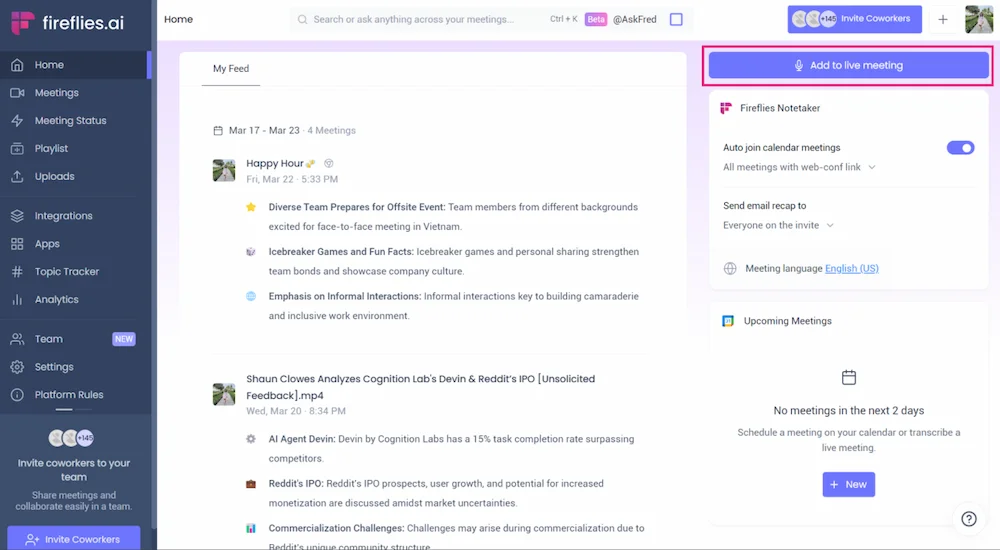
Fireflies.ai does everything Otter.ai does and then syncs it directly to your CRM. For solopreneurs managing client relationships without a dedicated account manager, that sync is the difference between meeting notes that inform your next conversation and meeting notes that sit in a folder nobody reads.
Key features:
- Automatic meeting transcription: Joins Zoom, Google Meet, and Teams calls, transcribes in real time, and delivers a summary post-call.
- CRM sync: Pushes meeting summaries, action items, and deal notes directly to HubSpot, Salesforce, and other major CRMs.
- Speaker analytics: Tracks talk time, sentiment, and engagement patterns across client conversations.
- Searchable archive: Query across every recorded meeting with natural language “what did the client say about pricing in Q1?”
Pros:
- Replaces your account manager, the CRM sync means every client touchpoint is automatically documented, organized, and accessible no manual data entry, no forgotten follow-ups.
- Relationship intelligence over time, six months of archived client conversations becomes a competitive advantage in renewals, upsells, and dispute resolution.
Cons:
- CRM sync requires paid plan, the free tier covers transcription but not the CRM integration that makes Fireflies genuinely powerful for solopreneurs.
- Accuracy on technical calls, transcription quality drops with highly technical jargon or domain-specific terminology.
Pricing:
| Plan | Price | Details |
|---|---|---|
| Free | $0 | 800 min/month transcription |
| Pro | $10/month | Unlimited transcription, CRM sync |
| Business | $19/month | Advanced analytics |
For solopreneurs managing more than five active client relationships, Fireflies Pro at $10/month pays for itself the first time it surfaces a forgotten commitment before a renewal conversation.
7. Make
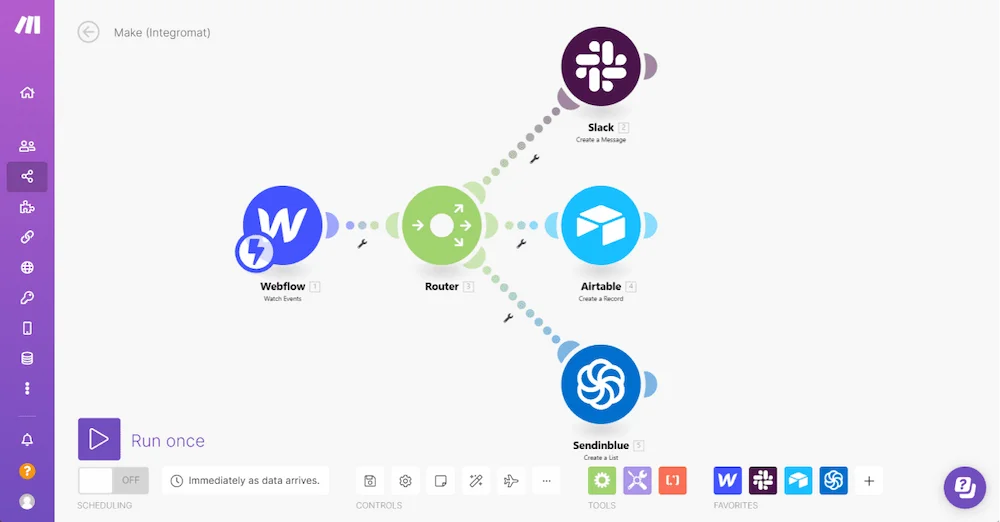
Make is the automation infrastructure that runs a solopreneur business in the background. Where Zapier charges per task and limits complexity on lower plans, Make’s visual scenario builder handles multi-step, conditional workflows at a fraction of the cost and its free tier includes 1,000 operations per month, enough to automate 3–5 core business processes before spending anything.
Key features:
- Visual scenario builder: Drag-and-drop modules for building complex, branching automations no code required.
- 1,000+ app integrations: Connects every tool in a solopreneur stack CRMs, email platforms, project managers, payment processors.
- Conditional logic: Builds workflows that make decisions based on data not just route it.
- 1,000 free operations/month: Genuinely functional free tier for solopreneurs automating 2–3 core workflows.
Pros:
- Replaces your automation engineer, Make handles the operational handoffs between every other tool on this list new client → Notion project → welcome email → calendar block, fully automated.
- Cost efficiency vs. Zapier, Make’s paid plans are significantly cheaper per operation than Zapier at equivalent complexity levels important for solopreneurs running high-volume workflows.
Cons:
- Steeper learning curve than Zapier, the visual canvas is more powerful but takes longer to master expect 3–5 hours of setup time before your first complex scenario runs smoothly.
- Error debugging requires patience, when a multi-step scenario fails, tracing the error through connected modules can be time-consuming without technical background.
Pricing:
| Plan | Price | Details |
|---|---|---|
| Free | $0 | 1,000 operations/month, 2 scenarios |
| Core | $9/month | 10,000 operations |
| Pro | $16/month | 10,000 operations + advanced tools |
Make is the connective tissue of the solopreneur stack. Individual tools deliver value in isolation; Make connected to all of them delivers a business that runs itself.
Which AI Tool Fits Your Solopreneur Stack?
Strategy-first solopreneurs vs. execution-first solopreneurs
Strategy-first solopreneurs consultants, coaches, advisors need tools that amplify thinking and client communication. The right stack here is Claude Pro for deep analysis, Perplexity AI for research, and Fireflies.ai for client relationship intelligence. Execution-first solopreneurs builders, creators, operators need tools that eliminate operational overhead. Motion for scheduling, Make for automation, and Notion AI for knowledge management cover the core. If you’re serious about automation, our complete guide to automating repetitive tasks is a good place to start.
Free tools vs. paid tools
You don’t need to spend $200/month to start operating like a team. Perplexity Free, Notion Free + AI at $10/month, Fireflies Free, and Make Free together cover research, knowledge management, meeting documentation, and basic automation at near-zero cost. The rule for solopreneurs is the same as freelancers: don’t upgrade until you’ve genuinely hit the free tier’s ceiling not because the paid version looks appealing.
Start Operating Like a Team Today
The best AI tools for solopreneurs shouldn’t feel like software you manage between client calls. They should feel like the team that handles everything else while you focus on the work only you can do.
Read our complete guide to the best AI productivity tools in 2026 to see how each tool fits into a full stack.
FAQ Best AI Tools for Solopreneurs (2026)
What are the best AI tools for solopreneurs in 2026?
The best AI tools for solopreneurs in 2026 are Claude Pro for strategic reasoning, Perplexity AI for market research, Motion for AI scheduling, Notion AI for knowledge and operations management, Copy.ai for marketing workflows, Fireflies.ai for client call documentation, and Make for business automation.
Can AI tools for solopreneurs actually replace hiring?
For most operational roles, yes. Among solopreneurs surveyed in 2026, 74% have scaled without hiring a single employee by leveraging AI automation for tasks that traditionally required full-time staff. The key is matching each tool to a specific business function not just using AI for writing.
What is the best AI tool for solopreneurs just starting out?
Claude Pro at $20/month is the best starting point for solopreneurs it handles strategic analysis, document review, content drafting, and business reasoning across one interface. Pair it with Notion AI at $10/month as your second tool and you have the thinking and operations layer covered for $30/month total.
How much should solopreneurs spend on AI tools for their business?
A complete AI stack covering strategy, research, scheduling, ops, marketing, and automation costs $75–150/month. Compare that to a part-time virtual assistant at $600–1,000/month for 10 hours weekly. The ROI case is not subtle.
Which AI tools for solopreneurs work best together?
The highest-performing combinations: Claude Pro + Perplexity AI for research and strategy, Notion AI + Make for automated operations, and Fireflies.ai + Make + Notion AI for client relationship management on autopilot.
How long before AI tools for solopreneurs show real results?
Claude Pro, Perplexity AI, and Fireflies.ai deliver value within hours of setup. Notion AI and Make require 2–3 weeks of configuration before delivering full workflow value. Motion typically shows measurable scheduling benefits within 10 days.
Are AI tools for solopreneurs secure for sensitive business data?
Claude Pro, Notion Business, and Fireflies Business all offer enterprise-grade data security and do not use your data to train their models on paid plans by default. For sensitive client data legal, financial, healthcare verify each tool’s data processing agreements before uploading confidential information.